
Management
Managing hybrid and distributed teams
Managing people you do not see every day is not the office routine run through a screen. One day on the rules to set from the start, objectives each person can own, rituals that hold across locations, and feedback and one-to-ones at a distance.
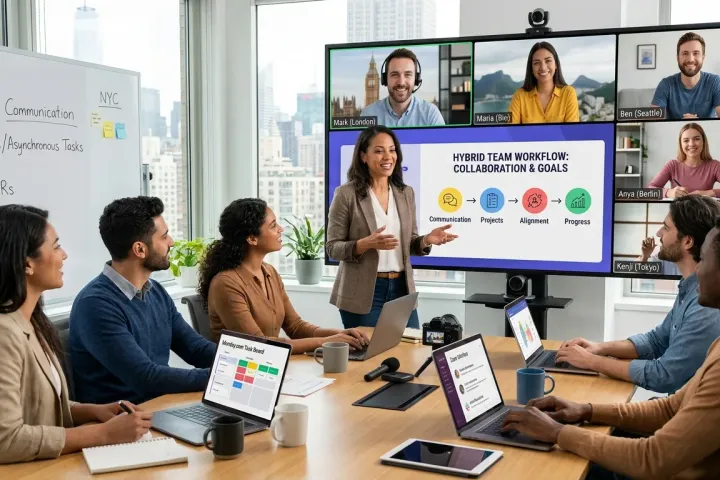
What you will be able to do
- Know the stages of managing at a distance
- Set clear objectives for remote and home working
- Put planned rituals in place with each team member and with the team
- Adapt your remote management to the personality of each team member
Programme
The main principles to respect
- The principles of managing at a distance
- Shared perspectives: the difficulties each participant meets when managing remotely
- Defining the prerequisites of remote management, in a workshop
The stages of managing at a distance
- How to raise the possibility of remote working
- The rules to set from the start
- Setting clear objectives for each person
Rituals, small and large, individual and collective
- The rituals to keep
- Organising the team's motivation at a distance
- A few tools to use
Recognising and correcting at a distance
- The balance between recognition and corrective feedback
- Practice and shared-reflection workshop
The remote one-to-one
- An essential management tool
- Each manager's own specific issues
Adapting remote management to each profile
- An introduction to a method for adapting to another person's behaviour
- Evaluation and close of the day
What this course gives you
Keeping motivation and team cohesion alive at a distance, and knowing how to combine delegation, ownership and trust.
During the day you discover the prerequisites and the essential advice for managing remotely or with people working from home. You also get time to share good practice with the group and to work collectively on your own issues. Finally, you see how to adapt your remote management to each person’s personality, motivation and skills.
Questions about this course
Should this course be run online?
We usually recommend it, yes — running a hybrid-management course entirely in a room is slightly self-defeating. The live online format also lets managers in different Gulf offices attend the same session, which is often the group that needs the shared vocabulary most.
Our company is fully back in the office. Is this relevant?
Possibly not, and we will say so rather than sell you a day. It stays relevant if you have colleagues in other cities, suppliers or clients you manage remotely, or a regional structure. If your whole team sits together every day, spend the budget elsewhere.
Can this be combined with another course?
Yes. It is a one-day module and combines naturally with the manager-leader toolkit or with the communication modules on running meetings. Combined programmes are assembled from whichever modules address your actual gap.
Related courses

The manager-leader toolkit
The core management programme. Three days covering the work a manager actually does day to day — setting the frame, delegating, running one-to-ones, handling the conversation nobody wants to have. The third day comes a few weeks later, once the tools have met a real team.

Motivating without a budget
Most managers have far less control over pay than over the things that actually drive engagement. This course covers the non-financial levers — autonomy, recognition, visible progress, meaning — and how to tell which one a given person responds to.
Visual management — first level
Visual management puts the few things that matter where the whole team can see them, and turns a short daily meeting into something people act on. One day to build your first board, decide what earns a place on it, and run the ritual without it turning into surveillance.